Sunday, February 21, 2016

Bernie Sanders: The Man, the Myth, the Legend

February 21, 2016
Feel the Bern
The "Doom and Gloom," Millennial Generation is quickly becoming the number one demographic that is supporting presidential hopeful: Bernie Sanders.  Being a Democratic Socialist, Bernie appeals to the portion of late-teen and early adult voters who feel economically unstable and overwhelmed by student loans.  Bernie may have overwhelming support from Millennials, but their support may be meaningless.  Younger generations, such as Millennials, do not account for a large portion of voters when election day arrives.  For example, the Millennials of Iowa only represented one-fourth of the electorate.

https://www.washingtonpost.com/politics/in-bernie-sanders-anxious-millennials-find-a-candidate-who-speaks-to-them/2015/10/27/923d0b74-66cc-11e5-9223-70cb36460919_story.html
The Iowa Caucus
The Millennial Population

Bernie Sanders's LIBERAL, economic policies largely favor the Millennial DEMOGRAPHIC.  The SALIENCY of the issues he is pushing is most dear to the Millennials, who must represent him more strongly in the POLLS if Bernie wishes to become the Democratic Presidential nominee.  Bernie Sanders is an IDEOLOGUE for universal, free education and a socialist economy.

Where Bernie Wishes to be

Wednesday, February 10, 2016

Education Reform

February 10, 2016


Standardized testing has been the bane of American youth for generations.  American students now witness superfluous hours of testing and tests that are not truly "standard."  Modern day education standards, including the "No Child Left Behind" Act, cause teachers to teach towards the test, thus robbing children of quality content.  The Department of Education and other smaller departments are currently aiming to reform test standards everywhere to make them fair and to end the objective of teaching towards a test.  Schools will soon be rated on student growth in addition to test scores.

(http://www.usnews.com/opinion/knowledge-bank/articles/2016-02-09/after-years-of-overtesting-education-is-right-sizing-standardized-tests)

Standardized Testing

Modern day education systems relate directly to the ideal of American FEDERALISM.  The FEDERAL SYSTEM of the United States allows the federal government to make test standards that the state governments must meet.  It is part of a STATE'S RIGHTS to create their own education system, yet they must still meet the federally MANDATED test requirements.  Education could be seen as a CONCURRENT POWER because it is shared between the state and the federal government.

Pennsylvania's Standardized Test


American Federalism

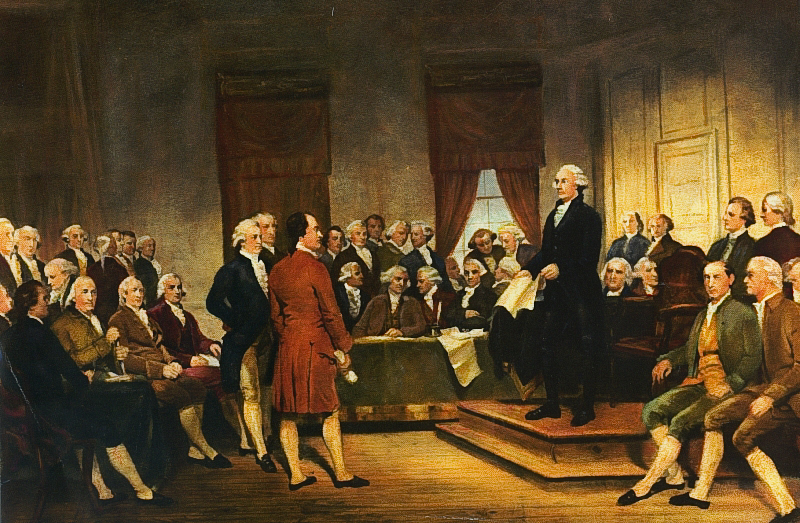
The idea American Federalism has been present since before the dawn of the American Constitution.  During the infancy of the United States of America (USA), the term federalism was used to represent the advocates of the American Constitution.  They advocated for a large FEDERAL government that was supreme, yet the national government would cooperate with the individual states.  It was later used as a term to describe the cooperation and inter-workings of the Federal and state governments.  The ideal of federalism has kept the USA unified, except for a short period of time, and in a state of peace.


Constitutional Convention: 1787

The USA has seen two forms of working federalism: layer cake (dual) and marble cake federalism.  Layer cake federalism consists of a federal and the several state governments, but they usually work separately and in different ways.  An example of layer cake federalism is the federal government's privilege to wage war.  It requires no initiative of the states and it is a supreme right of the national government.  Marble cake federalism is the cooperation of both the federal government and state governments.  Examples of marble cake federalism are the education systems throughout the fifty states.  It is the job of the states to create their own standards and testing (such as the Keystones), but the federal government creates test standards.  The federal government even create requirements for school lunches.


Layer Cake Federalism

Several court cases have helped define the restrictions and powers of government that correlate to the idea of federalism.  McCulloch vs. Maryland helped define the right of the federal government to start a national bank, thus allowing them to tax and regulate interstate commerce.  The case also prohibited the state government of Maryland from taxing the national bank.  McCulloch vs. Maryland depicted the strict separation that occurred under layer cake federalism.  Another court case that displays the separation of the federal and state governments that manifested under early federalism is Gibbons vs. Ogden.  The case gave supreme power to the federal government to alter interstate commerce and to restrict monopolies.
McCulloch v. Maryland

Many believe (mostly conservatives) that America is presently seeing the death of federalism.  They believe the federal government is taking control over every facet of civilians' lives.  An example of the end of federalism is the aid given to states.  The federal government gives uncountable aid to the states: so much that many states receive more in aid than they do from their own taxes.  Many discussions about present day federalism lead to debates about states' rights and Reagan's revival of "New Federalism," which has seemingly been demolished.  How can federalism exist if the states have little to no power to wield?  Where does the component of cooperation manifest?


Ronald Reagan
A Modern Day Federalist

American federalism has helped shape the USA into what it has become today.  Federalism was conceived to bring about a change to American government.  Federalism has defined the powers of state and federal governments.  Federalism has also led to the cooperation between states and the federal government for the good of the American people.  It has been successful  in creating a nation of individuality that is also a strong whole.

https://www.youtube.com/watch?v=J0gosGXSgsI
(Crash Course: Federalism)