 |
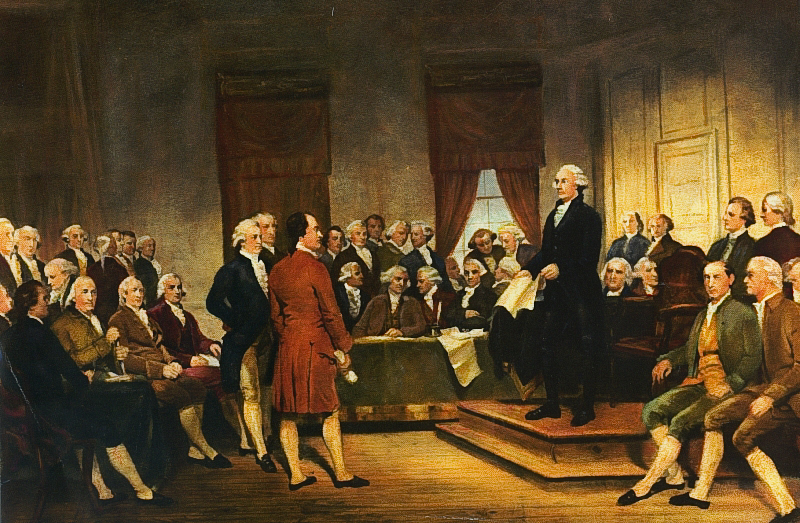
| Constitutional Convention: 1787 |
The USA has seen two forms of working federalism: layer cake (dual) and marble cake federalism. Layer cake federalism consists of a federal and the several state governments, but they usually work separately and in different ways. An example of layer cake federalism is the federal government's privilege to wage war. It requires no initiative of the states and it is a supreme right of the national government. Marble cake federalism is the cooperation of both the federal government and state governments. Examples of marble cake federalism are the education systems throughout the fifty states. It is the job of the states to create their own standards and testing (such as the Keystones), but the federal government creates test standards. The federal government even create requirements for school lunches.
 |
| Layer Cake Federalism |
Several court cases have helped define the restrictions and powers of government that correlate to the idea of federalism. McCulloch vs. Maryland helped define the right of the federal government to start a national bank, thus allowing them to tax and regulate interstate commerce. The case also prohibited the state government of Maryland from taxing the national bank. McCulloch vs. Maryland depicted the strict separation that occurred under layer cake federalism. Another court case that displays the separation of the federal and state governments that manifested under early federalism is Gibbons vs. Ogden. The case gave supreme power to the federal government to alter interstate commerce and to restrict monopolies.
 |
| McCulloch v. Maryland |
Many believe (mostly conservatives) that America is presently seeing the death of federalism. They believe the federal government is taking control over every facet of civilians' lives. An example of the end of federalism is the aid given to states. The federal government gives uncountable aid to the states: so much that many states receive more in aid than they do from their own taxes. Many discussions about present day federalism lead to debates about states' rights and Reagan's revival of "New Federalism," which has seemingly been demolished. How can federalism exist if the states have little to no power to wield? Where does the component of cooperation manifest?
 |
| Ronald Reagan A Modern Day Federalist |
American federalism has helped shape the USA into what it has become today. Federalism was conceived to bring about a change to American government. Federalism has defined the powers of state and federal governments. Federalism has also led to the cooperation between states and the federal government for the good of the American people. It has been successful in creating a nation of individuality that is also a strong whole.
https://www.youtube.com/watch?v=J0gosGXSgsI
(Crash Course: Federalism)

No comments:
Post a Comment